Writing Buddhism into Fiction
Curious about what it would look like? In this article I explore some of the ways I use Buddhist principles in world-building for my fantasy fiction novels.
About me: I was born a Buddhist of the Theravada tradition. I’m of Sri Lankan descent, born in Canada. I was two-eyed seeing before I knew what that was. My parents were adamant that I know where I come from and what we should believe. At the same time, growing up as a late Gen-Xer gives me a very specific flavour of grit and understanding of determinism. I write mythological fantasy with my world-building formed by my research into Buddhist Cosmology.
The first warning on my books is that everybody dies, in the Pawn of Samsara Duology at least. I wrote the two books from the perspective of the immortals who are held to a punishing high standard by Samsara.
Everything and Everyone is in a state of change. This means immortals also evolve and devolve, though their life span may be vast. Diving into the cosmology, other beings exist (akin to the Western beliefs around elves, faeries, goblins, etc). Reproduction is not necessarily biological. Two Asura can make a ‘child’ come into being. Their child might be born as an adult or as an animal. There are parallels with Greek and Roman mythology.
There’s no pattern or predicting Karma. Karma Vipaka is the law of moral causation that is ruled by intention. For this reason, unintentional actions may have minor effects whereas an intentional action may rebound over many lifetimes. To give an example, a desire to be with a person, may tie that person to you for multiple future lives. At the same time, you may grow to hate that person in one life but have loved them in another. In either instance, you’re with that person. As you can imagine, the spin off Karma becomes complex.
Samsara is the matrix. The first time I watched the Matrix, I was blown away with its parallels to Buddhist ideology. How do you escape the matrix? It’s not by fighting unfortunately. This is where the universal message from most religions come in—acceptance, faith, balance, and equanimity. Do no harm. Regulate your emotions. While meditation plays a part, the noble eight-fold path provides the instructions to living life intent on calming the waters of Samsara.
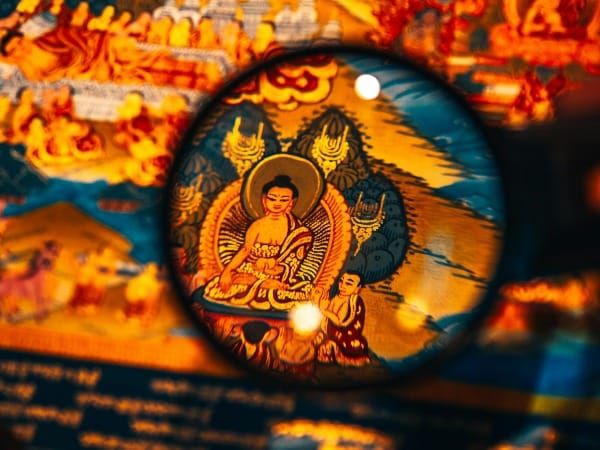
A Buddha only arises when there is none. There have been many Buddhas over eons of human (and I believe other being) civilizations. The best stories happen when the Buddha is absent. What this looks like is the chaos of not following the principles of Buddhism, and the steadiness of stumbling on them by accident. There’s a reason the parallels between religions are universal truths. There will always be a silent Buddha or quiet teachers of the Dhamma who guide and show people the way (in pockets) in periods of chaos.
How does this look in my books?
- The subtle changes in the Greater Gods over 1000s of years. In Buddhism specific gods are mentioned: Lord Sakka, Lord Ishwara, and Lord Suriya—who I like to believe later evolved into our present day Vishnu, Brahma, and Shiva. They’re not a direct overlap by any means. Lord Sakka roughly translates to the King of the Gods. Lord Suriya, Lord of the sun. Lord Ishwara is the ‘essence of the universe’. The Buddha talks about Gods who achieve an understanding of the Dhamma, and that they too are impermanent, who spend the remaining years of their existence in specific realms until whatever time they cease to be. Once they find the Dhamma, they generally decide to renounce their existance in preference of moving on to wherever they need to be next.
- How do you become a god? Mythology and gods are born by the actions of individuals. You save a collective from a danger and may become deified. This is why belief plays such a pivotal role in consequences. Some leaders simply can’t fall because of the power of belief. We see this in famous political figures and artists.
- The difference between gods and demons. Asura are thrown around as both good and evil—it depends on who’s asking. They are not human.
- The importance of humans as the single type of being who has free will or the power of choosing their intent. Humans straddle a hell world, Niraya. We can live in a hell or live in a heaven and what we do, directly translates to whether or not we can escape Samsara.